
Hollow Men Suite: Robert Motherwell and the Language of Shapes

Robert Motherwell’s Hollow Men Suite #7 (1986) reveals how simple shapes act as characters in dialogue; asserting, resisting, and transforming through repetition. This Musing explores visual weighting, mark-making, and the language of abstraction, showing how meaning emerges not from representation but from relation.
Describe, Analyse, Evaluate

Understanding the difference between
description, analysis, and evaluation is
essential for developing strong writing
in IBDP Visual Arts. These three steps
move students from observing what
they see, to explaining how it works, to
judging why it matters.
Writing the Rationale

The Rationale (RA for SL / SRA for HL) is a concise text accompanying the student’s body of resolved artworks. It provides insight into the conceptual intentions, technical and stylistic choices, and coherence of the selected works. A strong rationale clearly justifies selection choices, connects works through themes, and explains how artistic intent evolved.
Writing Reflections
Strong reflections are essential for deepening artistic comprehension & refining creative practice. They help students synthesize their artistic inquiry, experimentation, & decision-making, enabling them to articulate connections between concept, technique, & meaning.
Word Limits
The IB Visual Arts course requires students to communicate their artistic inquiry and analysis effectively within strict word limits. Writing concisely whilst ensuring depth and clarity is crucial for higher marks.
This card provides strategies for both teachers and students to refine written work and meet IB expectations efficiently.
Visual Mapping Tools
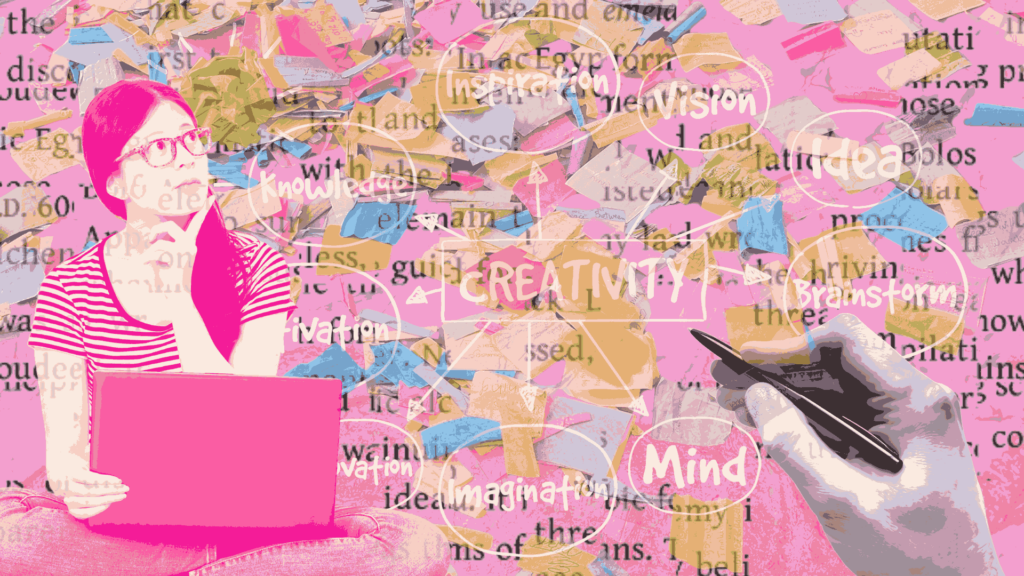
Visual mapping tools help students organise their ideas, research, and artistic inquiry in a structured and visually engaging way. These tools can help students develop connections between concepts, identify themes, and track artistic growth over time.
Sentence Starters

Writing effective annotations in IB Visual Arts requires a thoughtful and analytical approach. Sentence starters provide students with structured prompts that help them move beyond simple descriptions and develop deeper reflections on their work.
Generative Statements + Inquiry Questions

A strong generative statement or inquiry question forms the foundation of an art project, guiding artistic exploration, research, and experimentation. It should be broad enough for flexibility but focused enough to provide direction.
In the Art-Making Inquiries Portfolio (AIP), students develop inquiry questions/ generative statements to shape their process. These evolve over time, deepening exploration and refining ideas.
Conceptual Depth
Conceptual depth is essential in IB Visual Arts, requiring students to develop meaningful, layered inquiries beyond surface-level ideas. Strong conceptual work connects personal, cultural, and artistic influences, creating artwork with intellectual and emotional impact.
Annotation Strategies
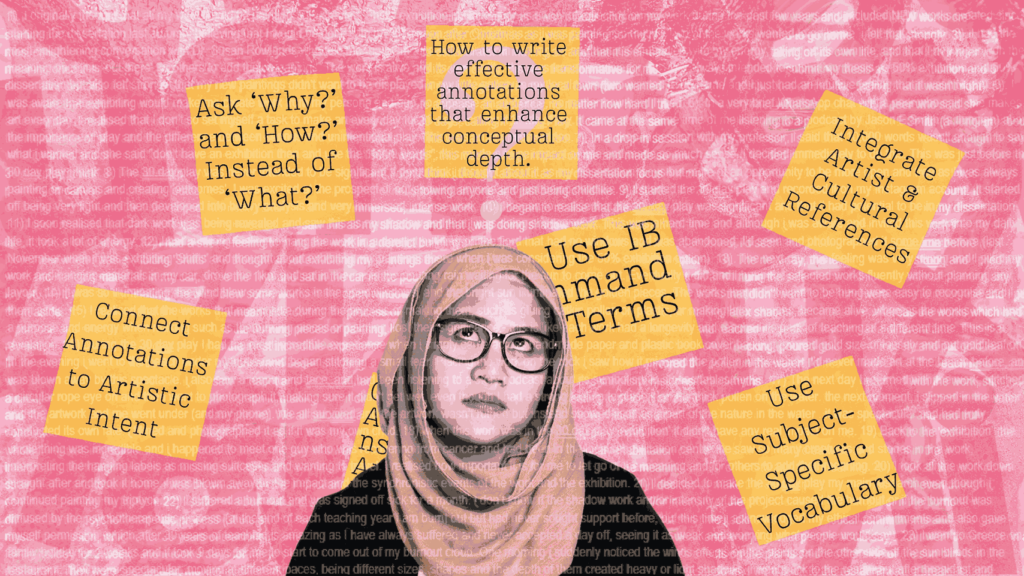
Annotations in IB Visual Arts should demonstrate critical thinking, analysis, and reflection, rather than simply labelling or journaling.