
When Young People Let Go of Control

This musing captures what happened when young people let go of control for the first time. Their marks revealed fear, memory, instinct, and identity in ways no test ever could. It’s a glimpse into Creative Intelligence: the human capacities that awaken when we stop performing and start listening.
Art, the Unconscious, and the Responsibility of the Artist-Teacher

In this Musing, I explore how art can become a dialogue with the unconscious, drawing on Jungian thought, Maria Konti’s research on response art, and my own practice as an artist-teacher to consider how creative process itself can lead to integration and awareness.
Consciousness Without Conscience

We are living in an age of immense consciousness but diminishing conscience. Our technologies expand faster than our capacity to feel, and the shadow we refuse to face is shaping the world around us. This Musing explores what happens when intelligence outgrows empathy, and how Creative Intelligence invites us to reunite consciousness with conscience, before it’s too late.
Creative Intelligence and the Jungian Mind

AI can recognise patterns, but it cannot feel meaning. This Musing explores how Creative Intelligence bridges the gap between technology and consciousness through a Jungian lens.
How to Assess the AIP Without the AIP

How do we assess the AIP without reducing it to slides? In this Musing I share why documentation should be treated as seeds for growth, not finished presentations, with practical strategies, a teacher reference sheet, and a student task you can use straight away.
Term 1 – Identity + Self: The Inner + Outer Worlds

This Musing gives an overview of Term 1, showing how our first Inquiry Thread has evolved into one monumental artwork that grows through painting, printmaking, mixed media, and sculpture.
Hollow Men Suite: Robert Motherwell and the Language of Shapes

Robert Motherwell’s Hollow Men Suite #7 (1986) reveals how simple shapes act as characters in dialogue; asserting, resisting, and transforming through repetition. This Musing explores visual weighting, mark-making, and the language of abstraction, showing how meaning emerges not from representation but from relation.
Montage: Disruption, Context, and the Unconscious

This Musing guides teachers through the second project of Thread 1 (T1_P2: Montage + Identity). It shows how to introduce montage through Hannah Höch’s The Beautiful Girl, how to weave context through dialogue, and how to help students balance intuition with compositional logic.
Equivalents: Teaching Photography as Inner Reflection
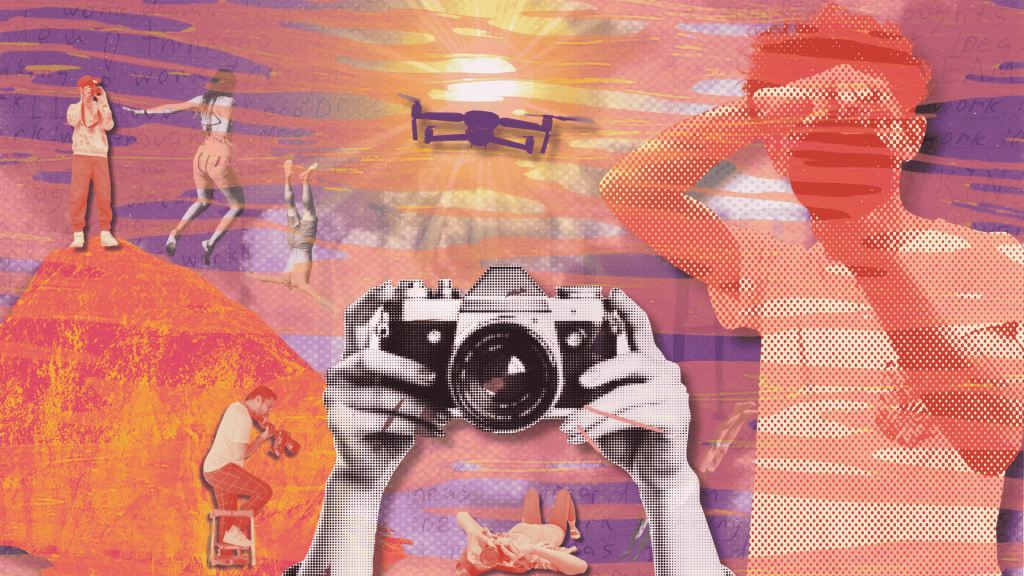
This Musings explores how Stieglitz’s Equivalents can guide students in seeing their own photographs as mirrors of the self. Through two models, structured writing with Description–Analysis–Evaluation (DAE) and intuitive reflection through narrative, it shows how to move from surface images into depth. With scaffolds, examples, and IB connections, it offers practical ways to help students trust intuition and write with clarity.
Speaking Out on IB Visual Arts Assessment

Visual Arts is one of the most demanding IB Diploma subjects, yet it continues to be marked more harshly than any other.
With the 2027 guide now launched, the question remains: will anything change, or will history repeat itself?